This is a bit of a rambling article, but I wanted to share just how wild this journey has been, and some of the connections I’ve been making since my deity confirmation call with Haleigh from The Witch of Hemlock. (If you haven’t had a deity confirmation before, I really recommend looking into one!)
First of all, I have been deconstructing from my past evangelical Christian belief system. I originally found Christianity when I was desperately seeking something, and truthfully, that something was community. But when you’re looking for a guaranteed weekly gathering, a place to belong, and people to connect with, sometimes you’re left with relatively few choices. And so began my Christian journey. Yet, throughout those years, I still believed in many of my spiritual and witchy things. I simply buried those parts of myself, tucked them away, and carried on for years.
Deconstruction began for me when I realized that somewhere along the way, I was having a midlife – or perhaps quarter-life – epiphany. Suddenly, I was becoming EXACTLY who I had always been, only with less of a need to cover it up and a much greater desire to feel free again. It wasn’t necessarily about becoming someone new, but rather uncovering the person who had been there all along.
I first encountered Bastet as the deity who walked me softly out of my past belief systems, and then Sekhmet roared into my life when I needed to burn away some shit that I couldn’t seem to burn away on my own. They each served a purpose during that season, but I believe they were ultimately guiding me toward a place that has always been my home. Once they had brought me to a place of acceptance within myself, their presence seemed to fade, and I was left to continue the journey on my own.
Coming from a religious system where devotion had a form, a function, and a relatively established pattern left me feeling completely out of sorts. I was accustomed to having ways to practice my faith, ways to connect, and a framework to follow. No longer feeling the presence of Bastet or Sekhmet also left me feeling bereft of that divine connection, and of course, there was still the heaping pile of guilt left over from viewing everything through my former Christian lens.
So I spent some time simply journeying and trying to find myself again. Not an easy task when you strip away so much of what you’ve known and begin examining what is actually underneath it all. Add to that a summer where things were stripped bare, truths were exposed, and my family and marriage were forged through some rather intense flames of transformation – but that’s an entirely different topic – and I found myself struggling to establish my spiritual practice amid everything else.
Enter Haleigh from The Witch of Hemlock. I began a mentorship program with her, where I have been able to ask questions, receive some wonderful guidance, and work through shadow work prompts specifically surrounding religious deconstruction. Slowly, I began finding pieces of myself again. Still floundering at times, certainly, but hey, there I was! Somewhere underneath everything, I was beginning to recognize myself.
What really shifted things into clarity, though, was a deity confirmation call. Ironically, Haleigh pulled the same tarot cards during part of my confirmation not once, but twice! Like, holy shit, man. Talk about a divine confirmation. I think part of my own hesitation had been my stubbornness, but also the watered-down versions of Greek mythology that I had grown accustomed to, thanks in part to Disney and other modern interpretations. I had never really considered Hellenic deities as part of my own practice, and yet Haleigh felt the strong presence of two, possibly three deities: Hermes, Pan, and Aphrodite. Naturally, with the resources she provided, I promptly disappeared down my usual 2 a.m. rabbit holes of research.
Aphrodite. Girl, she was a difficult one for me to reconcile at first, but the more I have studied her, the more I understand why she might have entered my life. It isn’t necessarily her most well-known aspects that resonate with me. Truth be told, it is her shadow aspects that have demanded my attention. I won’t dive into those personal reflections here, but let’s just say, yes, Aphrodite, I see you. I hear you. And balance is slowly being brought back into my life, through healthier and more appropriate channels. It is one thing to read a deity’s mythology, listen to their stories, and form an opinion about their actions. It is another thing entirely to encounter the less beautiful stories and recognize reflections of your own mistakes, choices, and things you must learn to live with. Perhaps that is precisely where my relationship with her is beginning. In the light and the darkness, the beauty and the ugliness. Because if there is one thing I have come to understand about Aphrodite, it is that beneath the beauty, there is ugliness too. There are actions, choices, consequences, and uncomfortable truths within her mythology. And sometimes those stories hold a mirror to my own life. Through that reflection, I feel called to be better, to do better, and to find a healthier relationship with myself, my desires, and my autonomy.
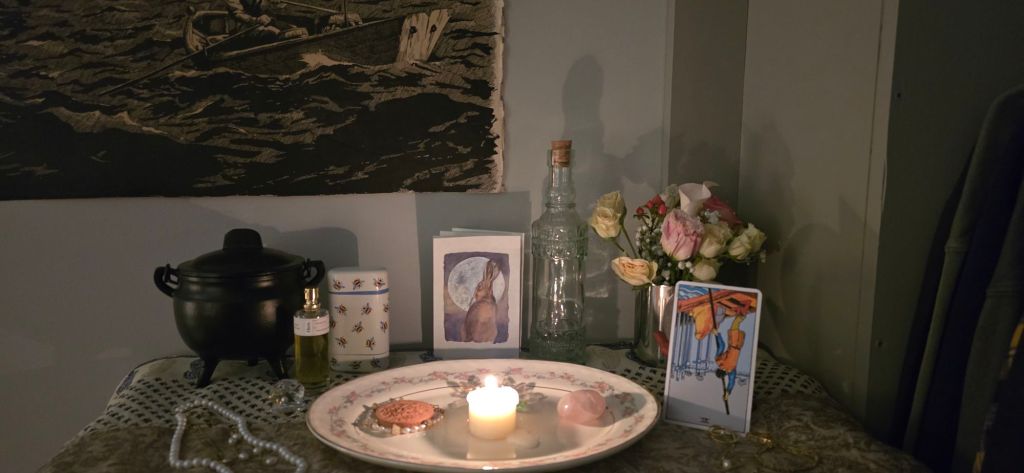
Hermes, though? My god, he is absolutely my patron. I genuinely believe that for years he has been there, quietly waiting in the wings. I love him. And the more I study him, work with him, and come to understand his nature, the more that affection grows. He is, in so many ways, everything that fascinates me. The liminal god, the traveler, the guide who crosses thresholds and moves between worlds. I’ll be honest, his shadow traits are also something I need to reflect upon, because he certainly isn’t without his own complexities. But personally, I have always loved the liminal. The in-between. The places where one thing ends and another begins, where boundaries become less certain, and where there is an opportunity to understand both sides of a space. In some ways, I have always loved being able to pass between those places myself.
The more I reflect on my life, the more I begin recognizing connections that make me wonder whether Hermes has been present in ways I simply didn’t have the language to understand before. Even my favorite books seem to carry echoes of his domains, particularly his role as a psychopomp, a guide of souls between the worlds of the living and the dead.
The Abhorsen series by Garth Nix has been one of my absolute favorite literary worlds for years. The Abhorsens themselves travel into Death, moving through its rivers and gates, guiding souls onward and preventing the dead from returning improperly to the world of the living. They carry bells that hold magical power, and music plays an important role in the movement between these realms. There is something so deeply fascinating to me about characters who can walk between life and death, who understand those boundaries, and who carry the responsibility of guiding souls through them. And then there is Hermes, who serves as a psychopomp himself, guiding the souls of the dead toward the Underworld. Different mythologies and fictional worlds, certainly, but the underlying themes feel remarkably familiar to me.
Then there is the Green Rider series by Kristen Britain, another series that will forever hold a place among my favorites. Karigan, the main character, finds herself crossing thresholds between worlds, encountering strange paths, supernatural forces, and the boundaries of life and death. Her journey eventually takes her into the role of an avatar connected with guiding the dead, and once again, there is that familiar fascination with someone who can walk between spaces that others cannot. Someone who travels the hidden roads, crosses boundaries, and moves through the liminal.
My fascination with these stories, my vivid dreaming, my love of thresholds and the spaces between, and even my desire to understand both the lighter and darker aspects of things have made me look at Hermes in an entirely different way. I find myself looking backward through my life and recognizing patterns that I never thought to connect before. Of course, that doesn’t mean every book I loved or every dream I experienced was necessarily a sign from him. But within my own spiritual understanding, those connections have become meaningful, and I can’t help but wonder whether the things that have always called to me were pointing toward something I am only now beginning to recognize.
Through these two deities specifically, I finally feel as though I am coming home. Home to myself, home to a spiritual practice that feels authentic, and home to divine relationships that allow me to embrace the complicated entirety of who I am. Not simply the beautiful or comfortable parts, but the darker and more difficult ones too.
Pan is another deity I intend to spend more time studying, particularly because of the connection I feel when I am out in the mountains, wandering through the woods, and exploring the places beyond established paths. I believe Haleigh recognized that there may be another deity calling to me from those wild spaces, and I am curious to see where that relationship might lead. For now, though, I am content to explore that possibility slowly, without feeling the need to define everything immediately.
What I am most grateful for is the sense of connection that has returned to my spiritual life. The rituals, the understanding, the practice, and the opportunity to develop relationships with the divine in ways that feel deeply personal. These are things I needed bone-deep during this season of my life. In some ways, beginning to incorporate more Hellenic pagan practices has returned something I didn’t realize I missed so terribly from my years within the church. It offers me rituals, sacred texts, traditions to study, and opportunities for regular devotion. There is a rhythm to it, a way to intentionally make space for the gods in my everyday life, and a framework that I can explore without feeling that I must abandon the freedom I worked so hard to reclaim.
Perhaps that is the most beautiful part of this journey for me. I spent so much time believing that freedom meant stepping away from established religious structures entirely, only to discover that I still deeply desire ritual, devotion, and sacred rhythm. The difference now is that I am learning to approach those things through choice rather than obligation, through relationship rather than fear, and through a practice that feels like an extension of who I am rather than something I must force myself to become.
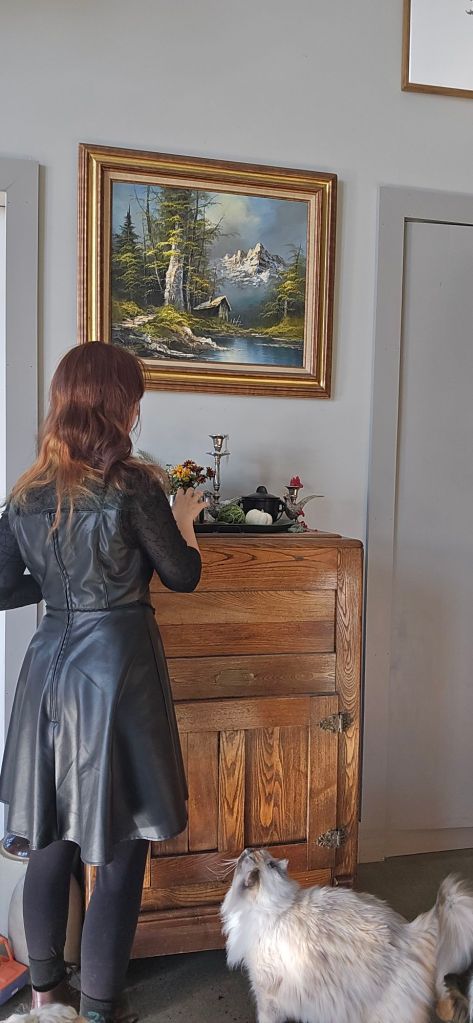
And somehow, through the gods, the stories, the shadows, and all those strange little connections, I am finding my way home.


Leave a Reply